Case Study · Schleich
Semantic product management for complex data structures
Flexible, fast and easy with Structr
Customer
Schleich GmbH
Industry
Toy manufacturer
Country
Germany
Structr use case
Schleich GmbH
Founded by Friedrich Schleich in 1935, the company is one of the largest toy manufacturers in Germany and an internationally leading provider of original play concepts.
Today, the famous Schleich plastic figures are sold in more than 50 countries worldwide.
Originally focused on the development, production and distribution of comic figures, the company expanded its range with lifelike animal figures. Many play worlds followed, such as knights, Native Americans and elves.
The design of the Schleich toy worlds, the manufacture of the production tools and the quality and safety testing are carried out in Germany. Production itself takes place at the company's site in Schwäbisch Gmünd and at further locations worldwide.
Key highlights
- New graph-based PDM solution implemented in less than six months
- Fast user interface for master data management
- Dedicated mini apps for specific business applications
- Flexible interfaces to SAP and other systems
- Traditional company since 1935
- Detailed, authentic figures to touch and experience
- High quality standards
Key highlights
Existing semantic wiki slow and inflexible
Complex, historically grown data model hampers further development
Proprietary, closed system with high licence costs
International quality and safety requirements hard to meet
Challenge
To manage heterogeneous data across the entire value chain holistically and efficiently in a single context, the toy manufacturer Schleich was looking for a new, flexible solution for product data management (PDM).
Because of its good scalability and speed, the company chose graph technology and Structr.
A cross-site semantic data model was already built during product development. Specially tailored mini apps give employees quick and easy access to relevant data. This enables Schleich to meet high quality requirements and country-specific safety regulations reliably and efficiently.
Read more
The biggest challenge in this project was not only to migrate a central, business-critical application with gigabytes of production data to an entirely new technology and system architecture, but also to clean up the data model and reduce it from almost 350 classes to fewer than 200 – while at the same time designing and developing new applications with new functions and data interfaces.
Schleich has a large number of historically grown, heterogeneous data structures. The toys are subject to strict legal regulations and require extensive material management – from the first design of a toy figure through production to distribution. Capturing data such as the individual parts of the toys, their quality standards and country-specific regulations, materials, production tools and ingredients is essential. Data from different systems (e.g. from component manufacturers or suppliers) and from different countries is integrated into the PDM system. Schleich employees use this complex data for their work along the entire value chain.
Schleich had developed the PDM system previously in use over several years and adapted it to its own needs. And although it already offered an integrated semantic network for product data, its generic user interface made the data difficult to handle and its administration laborious.
Strategy
The existing system no longer met the requirements for greater flexibility, performance and usability. One of the main tasks was therefore to reduce the confusing data model, which had been inherited from the previous system and had grown over time, to a sensible and clean new core model without losing any functionality.
It quickly became clear that the only way to access the data was to convert it completely into the RDF/OWL format. Access was only possible through the external user interfaces of the existing system. The goal was to put all data into a semantic context and to process it across the entire company.
“Especially in the toy industry, it is important to meet the highest quality and safety standards,” says Dr.-Ing. Andreas Weber, Vice President Operations at Schleich. “Our employees should be able to access relevant data easily and quickly along the entire value chain. Transparent proof of compliance with all legal requirements is essential. That is why the old data silos had to be replaced step by step.”
Solution
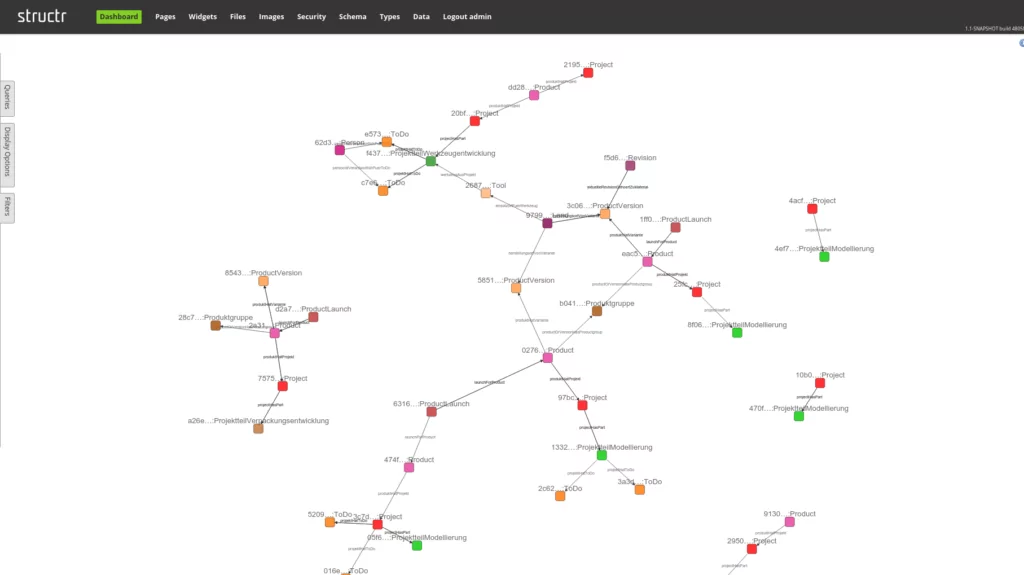
To build a flexible, scalable system, Schleich opted for a new PDM system based on the open-source low-code software platform Structr and built on a graph database – a combination that drastically simplifies and accelerates the development of software solutions. User interfaces optimised for individual requirements can be implemented within a few days. Interfaces to other systems guarantee a high degree of integration.
Read more
With the highly flexible software platform Structr, not only simple things such as extending the data model with new attributes at runtime or adding new elements to the user interface can be done in no time. New classes, relationships and additional functionality can also be added, from simple things like a new type to more complex revisions of the data model. In both cases, these kinds of change requests lead to highly complex changes at the technical level, such as changing the class inheritance or migrating data from a simple attribute to a new complex type.
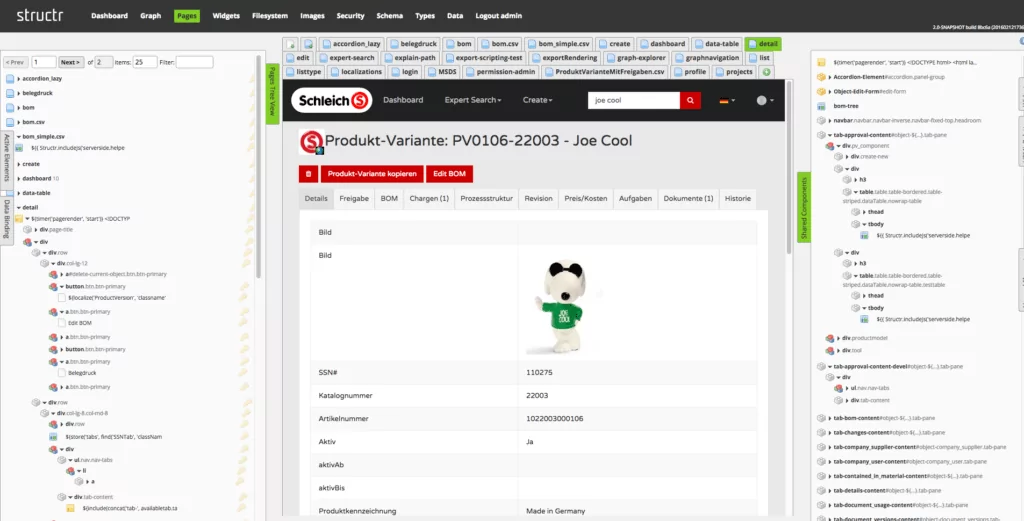
Structr also lets you develop mini apps tailored specifically to the technical needs of employees. All data is hidden behind the respective apps and consolidated in the database. The mini apps are tailored to user groups and differ, for example, in their user interface and usability. Apps with flexible front ends for web and mobile devices can be created in no time. This is where the flexibility and speed of graph technology come into play. The departments access the functional modules through individual user interfaces, and users can work in the systems in parallel in multi-user mode within the departments.
- New graph-based PDM solution implemented in less than six months
- Fast user interface for master data management
- Dedicated mini apps for specific business applications
- Flexible interfaces to SAP and other systems
In addition to improved transparency in quality assurance and PDM, we can now plan and track all processes along the value chain much more effectively.
Cross-departmental semantic data context
Efficient workflows across the entire value chain
Powerful, intelligent system platform
Result
The project at Schleich was technically and conceptually demanding. The agile approach would not have been possible without a truly flexible software platform like Structr and an enterprise-grade, schema-flexible graph database like Neo4j.
Within just six months, the new PDM solution was implemented at Schleich and the entire data stock was migrated. “Having mini apps available as functional building blocks lets us make much better use of the system,” says Weber. “And with this approach we were able to increase the system's performance significantly and implement change requests and individual views of the data much faster.”
Read more
For example, employees can use a mini app with bills of materials to get precise information about the raw materials used in the products. This lets them check compliance with legal guidelines and adapt their designs where necessary. The entire value chain, from raw material manufacturers and suppliers to in-house production, can be clearly displayed and traced, e.g. for materials management and compliance. In addition, legal changes can be checked for their impact quickly and easily.
Predefined access rights in the mini apps allow external groups to view and edit relevant data. In the medium term, external laboratories will also be able to import their data directly into the system. Integrating externally available data sets, such as ECHA's SVHC list, is just as easy. Thanks to its open system architecture, the Structr platform can be integrated into the company's heterogeneous system landscape.
Directly coupling the new system to the SAP system introduced at Schleich at the time also made it possible to cover almost all PDM-specific requirements with the new platform. SAP stayed very close to the standard and could be rolled out site by site. This saved the toy manufacturer costs and reduced the complexity of its IT infrastructure.
Would you like to learn more about how Structr was used in this solution?
Feel free to contact us at any time on +49 800 / 78 78 287 or send us an email at contact@structr.com. Alternatively, use our contact form.

Christian Morgner
Thank you for your message
We have received your request and will get back to you within one business day.
Urgent? Call us at +49 800 / 78 78 287.
Oops, something went wrong
Your message could not be sent. Please try again in a moment.
Still not working? Call us at +49 800 / 78 78 287 or write to contact@structr.com.