Custom enterprise content management (ECM) system development
We develop highly flexible all-in-one enterprise content management systems based on a Neo4j graph database. With our Structr development platform, ECMs can be built both as a headless CMS and as complex content hub software to store, manage and edit data centrally.
An ECM prototype in 3 days –
Need a fast and cost-effective solution? We build a working prototype of your enterprise content management system within 3 working days.
Structr is a software company with more than 15 years of experience in developing professional graph database solutions for complex data structures. We have already delivered custom data management systems for companies such as Schleich, Lufthansa, DHL and Amprion.
We would be happy to develop your custom enterprise content management system together with you, tailored precisely to your company's requirements. Call us any time on +49 800 / 78 78 287 or use our contact form to book a meeting.
A custom enterprise content management system from Structr stands out for its full-stack approach with native Neo4j graph database technology and an integrated low-code UI builder. As a result, ECMs built with Structr offer maximum flexibility in the features they can provide, including content indexing, intelligent full-text search and granular role management.
The main advantages of Structr enterprise content management systems are secure access to important business documents, fast graph-based data organisation and search, noticeable time savings and tailor-made content workflows.
On this page, we describe the development of custom enterprise content management systems and explain their particular advantages.
Custom enterprise content management systems from Structr
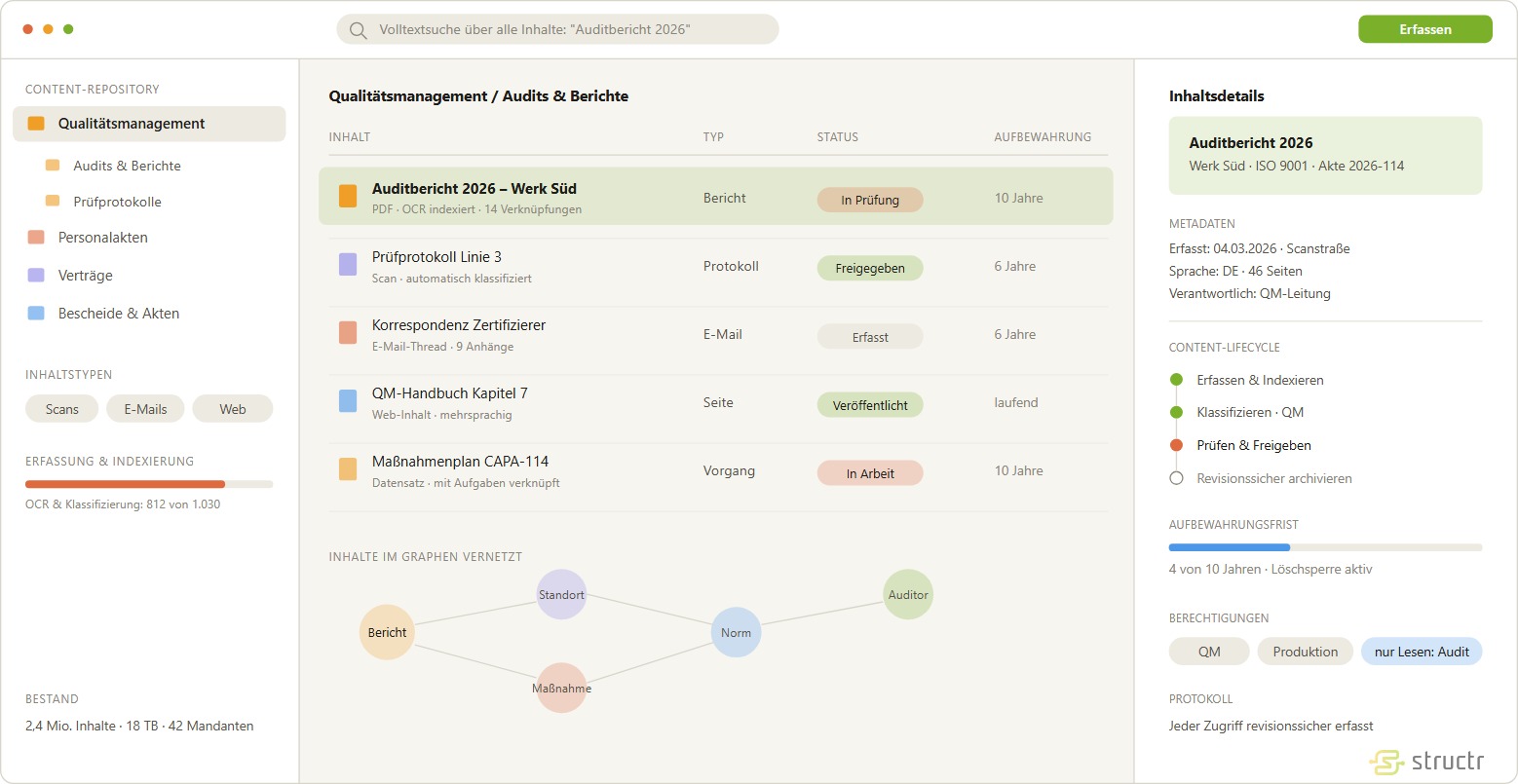
Custom enterprise content management systems (ECM) from Structr are tailor-made full-stack solutions for the professional capture, indexing and management of business content.
A Structr ECM stands out for its high flexibility and scalability. It can be used both as a complex content hub and as a headless CMS. It serves as a central data source that integrates seamlessly into any existing technical infrastructure.
The graph-based organisation of Structr enterprise content management systems allows content components and metadata to be stored without redundancy in a native Neo4j graph database. The graph database makes it possible to link content from isolated systems intelligently, categorise it with a uniform keyword catalogue and query it efficiently through a central full-text search.
Read more.Read less.
The visual schema editor used to develop the ECM allows 100% customisable content structures. With the schema editor, you can define tailor-made content containers and specific type classes for your individual content structures. Unlike off-the-shelf software, Structr ECMs do not force you into a predefined standard backend.
Structr enterprise content management systems come with integrated digital asset management (DAM). The system works with an integrated file system for managing documents and media. Metadata is organised centrally in the graph, while files are stored on any server or in the cloud. Features such as full-text search and optical character recognition (OCR) are easy to implement with Structr.
A Structr ECM enables smooth and fast system integration through automatic APIs. Automatically generated JSON/REST interfaces make it easy to deliver structured content to custom web applications, classic CMS or external systems.
Thanks to its full-stack approach combined with a Neo4j graph database system, Structr allows a wide range of possible features and areas of application, which we describe in more detail in the following sections.

ECM system features
Structr can be used to build an enterprise content management system (ECM) with a wide range of features. These include, for example, the capture, indexing, organisation and management of content, intelligent full-text search, granular rights and role management, and audit-proof archiving.
In the following list, we describe typical ECM system features in detail.

-
Content capture and indexing
A Structr ECM system supports you in capturing and indexing content. All information is captured centrally, enriched with structured metadata and tagged intelligently.
-
Content organisation and management
Structr ECM systems help you organise and manage content. The Structr ECM creates a dynamic information architecture instead of confusing standard folder structures. Our system links documents logically and places them in the right business context for productive cross-departmental work.
-
Intelligent full-text search
Thanks to graph-based technology, Structr enterprise content management systems allow fast and intelligent full-text search. Even very large amounts of data and complex relationships can be captured by the system in fractions of a second. The search covers not only file names and metadata, but also the complete text content of documents.
-
Granular rights and role management
Structr enterprise content management systems allow granular rights and role management. Granular rights and role management protects sensitive data from unauthorised access. With clearly defined permission concepts, you control exactly which users or user groups may view, edit, share and delete specific content.
-
Audit-proof archiving
An ECM developed with Structr ensures audit-proof archiving. An ECM helps you comply with statutory retention periods under GoBD and GDPR. The system makes it easier to store your business-critical documents and data in a tamper-proof and encrypted way.
ECM use cases
Typical use cases for Structr enterprise content management systems (ECM) include human resources, contract management, quality management, public administration, and production and logistics.
In the following list, we describe typical use cases of ECMs developed with Structr.

-
Human resources
Structr enterprise content management systems are ideal for human resources. The ECM brings together all employee information, employment contracts and references in one central place. Automated workflows speed up onboarding and offboarding processes. A fine-grained permission system ensures that highly sensitive personnel data is handled in strict confidence and in compliance with the GDPR.
-
Contract management
A Structr ECM can be used effectively in contract management. With an ECM for contract management, you keep track of the entire life cycle of your contracts. The system monitors terms and reminds you automatically and in good time of notice periods and renewal options. Complete versioning ensures that everyone involved always works with the current version of the contract.
-
Quality management
Quality management is a common use case for Structr enterprise content management systems. In quality management, compliance, transparency and complete documentation are essential. The Structr ECM supports you in creating, approving and archiving standard operating procedures (SOPs), certificates and inspection reports in an audit-proof way. Transparent audit trails show at any time who made which changes and when.
-
Public administration
A Structr enterprise content management system is ideally suited to public administration. Authorities and public institutions face the challenge of digital record keeping. A Structr ECM allows citizen and administrative data to be stored and managed securely and in compliance with data protection rules. Automating standardised administrative processes with an ECM leads to noticeably faster case handling and efficient communication.
-
Production and logistics
Production and logistics are a common use case for Structr enterprise content management systems. Delivery notes, production orders and technical documentation must be quickly accessible at machines and workstations. The Structr ECM connects seamlessly to existing ERP systems, ensuring the flow of information along the entire supply chain. Integrating an ECM avoids information gaps and speeds up production processes.
Reviews of our ECM systems
Below you will find reviews of ECM systems we have developed for our customers.
Enterprise content management case studies
Below we present a selection of enterprise content management case studies from Structr.

Mastering complex product data with Structr
How Plan.One benefits from graph technology to manage complex metadata.
Read the case study
Smart booking system for unique holiday homes
How URLAUBSARCHITEKTUR used low-code and graph technology to build a custom, flexible solution for renting out holiday properties.
Read the case studyAdvantages of our enterprise content management systems
The advantages of our enterprise content management systems are secure access to important business documents, long-term digital readability, noticeable time savings, fast graph-based organisation, high flexibility thanks to the full-stack approach, BSI-certified security and tailor-made content workflows.
In the following list, we describe the particular advantages of our enterprise content management systems in detail.

-
Secure access to important business documents
A Structr ECM makes important business documents securely accessible. A granular rights and role system tailored to your company ensures that sensitive data is protected, so only authorised people can view or edit it.
-
Long-term readability of digital documents and data
Our enterprise content management system ensures that digital documents and data remain readable in the long term. By supporting common, GDPR-compliant archiving standards, the ECMs we develop make sure that historical company data can still be used in the future.
-
Noticeable time savings
An ECM developed with Structr saves not only money but also time. The innovative graph database technology and architecture of Structr as a development platform enable fast searches, even across complex, interconnected data structures.
-
Fast graph-based organisation and search
An ECM developed with Structr enables fast graph-based organisation and search of data. All content components and their metadata are stored in a native Neo4j graph database. The graph database lets you link content intelligently, categorise it with a uniform keyword catalogue and query it efficiently through a central full-text search.
-
Flexibility through the full-stack approach
Thanks to the full-stack approach, Structr enterprise content management systems offer maximum flexibility. We do not simply couple tools loosely together. We deliver everything in one piece of software, from the data model to the finished user interface (UI).
-
BSI-certified security
Structr has been successfully audited by the BSI (German Federal Office for Information Security) and meets the highest security standards. In addition, we continuously carry out security screenings to ensure data security. The platform's source code is continuously checked for vulnerabilities with the help of AI models.
-
Tailor-made content workflows
Structr enterprise content management systems give you tailor-made content workflows that map your business processes exactly. Projects are dynamic and call for quick changes. With Structr, approval and editing processes can be modelled and adapted flexibly with the visual flow engine or by script.
The ECM development process
The ECM development process comprises a detailed consultation, ECM prototype development in a very short time, a workshop, and hosting and long-term support.
The following list explains the exact process of our ECM development in 4 steps.

-
1
Detailed consultation on ECM development
In the first step of ECM development, we hold a detailed consultation with you. In the consultation, we discuss how company information, content and unstructured data (documents) are captured, managed and provided in your business in order to record the current state. We then talk about which core functions are needed to set up the ECM as the information and distribution hub for your company. These include, for example, the necessary cross-departmental workflows for automating routine tasks, an intelligent search and a governance framework for access control. In the consultation, we also discuss the connection to existing ERP and CRM systems in order to capture the interfaces precisely.
-
2
ECM prototype development
After the consultation, we develop a prototype of your enterprise content management system within a few days. The prototype comprises the future information architecture, the user interface (UI) and all the functions discussed for capturing content, distributing information intelligently and searching. When we present the prototype, we check together whether your business processes and digital workflows are mapped optimally, and identify potential for optimisation to achieve the best possible usability.
-
3
Workshop on your custom enterprise content management system
After the ECM prototype development, we offer you a workshop on your custom enterprise content management system. In the workshop, you have the opportunity to try out the system in full using sample company content. We explain how it works and how to operate it, and show you how to make the most of the ECM's full potential.
-
4
Hosting and long-term support
We offer secure hosting and long-term support for your Structr ECM. We take care of regular updates and maintenance in the background and look after your concerns whenever you have questions about how to operate your enterprise content management system or how it works.
How much does an enterprise content management system from Structr cost?
The exact cost of an enterprise content management system from Structr varies depending on the complexity of the system.
For the prototype development of an enterprise content management system alone, we usually charge a fixed price between EUR 5,000 and EUR 15,000.
Contact us about ECM development
Feel free to contact us any time on+49 800 / 78 78 287, send us anemailor use ourcontact form.

Axel Morgner
Thank you for your message
We have received your request and will get back to you within one business day.
Urgent? Call us at +49 800 / 78 78 287.
Oops, something went wrong
Your message could not be sent. Please try again in a moment.
Still not working? Call us at +49 800 / 78 78 287 or write to contact@structr.com.