Custom HRMS development: Human Resources Management System
We develop tailor-made HRMS software that makes your HR processes more efficient and supports your personnel management for the long term, with a high-performance Neo4j graph database, a low-code UI builder and AI integration.
An HRMS prototype in 3 days –
Need a fast and cost-effective solution? We build a functional prototype of your human resources management system within 3 working days.
Structr is a software company with more than 15 years of experience in developing custom human resources management systems and other bespoke software. We have already worked with companies from a wide range of industries, such as Schleich and DHL, as well as with public sector institutions.
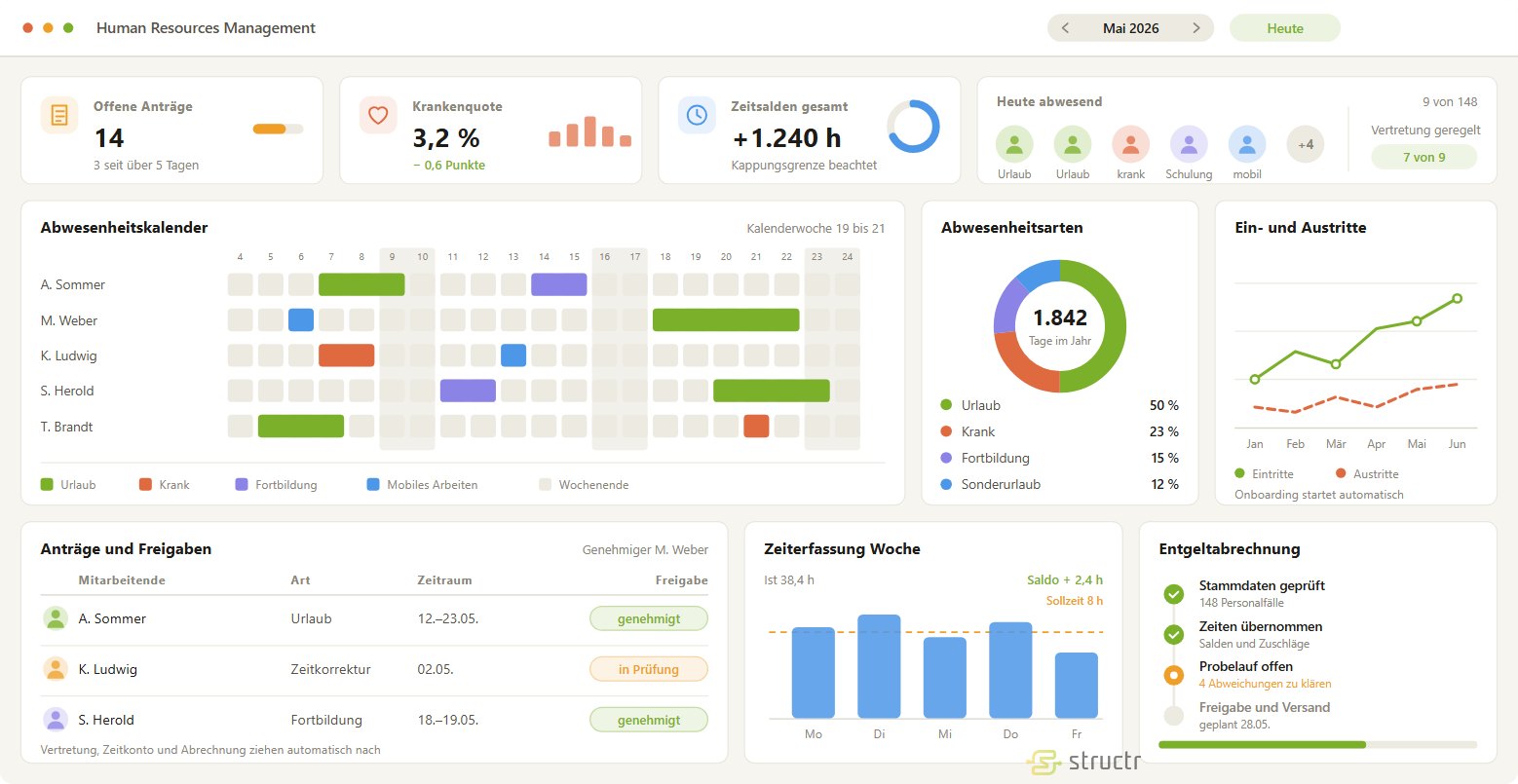
A modern HRMS brings all personnel and skills data together in one central system. As a single source of truth, the HR management system simplifies personnel administration and recruiting and enables detailed HR analytics with intuitive employee self-service portals.
On this page, we look at the particular benefits of HRMS development with Structr and describe the key functions of our custom-built human resources management systems.
Custom HRMS development
We develop your custom HRMS for you in a very short time. You receive software tailored specifically to your HR processes, based on a powerful Neo4j graph database with an integrated low-code UI builder and AI support.
Structr makes it possible to develop high-performance software in a very short time. The combination of low-code tools, a native graph database and AI generation shortens the development time of a prototype from weeks to just a few days.
With the integrated low-code UI builder, employee self-service portals and HR dashboards can be created easily and cost-effectively. The low-code tools enable fast visual data modelling via drag and drop. Data types, attributes and relationships are defined visually, directly in the graph, and take effect within milliseconds. As soon as a new type is created in the schema editor, Structr generates REST APIs fully automatically.
Read more.Read less.
The native Neo4j graph database in Structr ensures a high level of technical performance that far exceeds that of conventional relational databases. Personnel structures are highly interconnected. Relational databases fail at highly complex queries about multi-layered skill profiles, department memberships, qualifications, skill gaps and training needs. The graph database maps these relationships visually and with high performance. The flexible data model makes it possible to add new attributes and departments during live operation, without a time-consuming database migration.
The AI support in the development tools for your HRMS helps with data modelling, automatic BPMN process generation and writing scripts. For end users, AI agents and LLM calls are natively available in every process step or script context of the application. In Structr, the integrated AI agents have transaction-safe read and write access to the entire Neo4j graph, so they work directly with real business data.
Structr's structured coding approach is a safe alternative to the uncontrolled generation of code through vibe coding. The AI translates human requirements into verifiable application descriptions at text level. Only after successful verification is this description transferred directly into the Neo4j graph database. The advantage is that the system deterministically generates exactly the same application structure from a requirement once it has been verified, which ensures predictable and fully auditable results.
Structr's open-source approach supports the best possible data protection for sensitive HR data such as salaries, contracts and health data. As an open-source platform, Structr allows maximum digital sovereignty without expensive vendor lock-in. If required, the HRMS can be run entirely on-premises on your own servers. This makes it possible for you to ensure GDPR compliance and to effectively protect data from access under foreign regulations such as the US CLOUD Act.

HRMS features
Key features of a human resources management system are the central management of personnel data and organisational structures, the management of compensation and employee benefits, recruitment and onboarding, compliance and HR analytics.
In the following list, we describe the most important HRMS features that can be implemented with Structr.

-
Central management of personnel data and organisational structures
An HRMS provides central management of personnel data and organisational structures. The human resources management system is set up as the single source of truth for all employee master data. Organisational structures are mapped naturally and with high performance in the graph data model.
-
Management of compensation and employee benefits
Human resources management systems manage compensation and employee benefits efficiently. With an HRMS, salaries, bonus payments, pay grades and additional benefits are managed transparently. With Structr, individual compensation models can be configured flexibly. Automatically generated REST APIs ensure that sensitive data is passed to external payroll systems in real time.
-
Recruitment and onboarding
An HRMS helps to automate recruitment and onboarding. The integrated BPMN process engine makes it possible to automate company-specific onboarding workflows. For example, once the contract has been signed, the system automatically assigns the new employee the necessary access rights, IT resources and mandatory training.
-
Compliance
HRMS software ensures compliance with legal requirements such as the GDPR, working time laws and documentation obligations. Structr systems allow fine-grained permission management, so that only authorised users may access salary data. As an open-source solution, Structr can be run with full sovereignty on your own servers.
-
HR analytics
An HRMS enables insightful HR analytics. Strategic personnel decisions require reliable data. Graph technology intelligently connects turnover rates, personnel costs, overtime and qualifications. Relational SQL databases fail at very complex queries in most cases. The Neo4j database ensures smooth real-time processing of the requested data.
HRMS areas of application
Typical HRMS areas of application are organisational management, leave planning, learning and development, recruiting, applicant tracking, time tracking and payroll.
The following list gives an overview of the most important HRMS areas of application.

-
Organisational management
A common area of application for HRMS software is organisational management. The Neo4j graph database in Structr HRMS software maps dynamic matrix organisations, cross-departmental teams and fine-grained reporting lines with high performance. Managers keep track of global and highly branched corporate structures.
-
Leave planning
An HRMS is ideal for leave planning. Without digital support, absence management takes a lot of time. With Structr, specific leave and substitution rules can be mapped precisely. Intuitive employee self-service (ESS) portals enable employees to handle leave requests and substitutions quickly and easily.
-
Learning & development (L&D)
An HRMS is often used in learning & development (L&D). Strategic personnel development links employee profiles directly with the required skills and training offers. Thanks to this effective linking, HR managers identify qualification and skills gaps in the company. The system can be set up to detect deadlines for mandatory compliance and safety certificates.
-
Recruiting
An HRMS from Structr can be used for targeted recruiting. Our system helps you manage job advertisements efficiently and publish them on different channels. It can be flexibly adapted to your employer branding and individual selection procedures, so that applicants feel well looked after from the very first interaction.
-
Applicant tracking
Companies use human resources management systems to support effective applicant tracking. A seamlessly integrated applicant tracking system (ATS) makes it possible to control the application process. With Structr, you define your own individual selection processes. Software developed with Structr adapts fully to your requirements for multi-stage selection processes. E-mail communication, interview scheduling and internal feedback loops are automated in a resource-efficient way.
-
Time tracking
An HRMS enables legally compliant recording of working hours and breaks. With Structr, highly complex shift schedules, flexitime models and industry-specific collective agreement rules can be mapped flexibly. Overtime and bonuses are recorded by the system and prepared transparently for controlling and accounting.
-
Payroll
A human resources management system developed with Structr supports companies with payroll. The HRMS brings together all pay-relevant data, such as recorded working hours, bonuses and tax classes. Automatically generated REST APIs make it possible to connect the HRMS to external payroll systems. This ensures automated data exchange without manual transfer effort.
Reviews of our HRMS software
Below you will find reviews of our HRMS software.
HRMS case studies
Below we present some of our successful HRMS case studies.

Mastering complex product data with Structr
How Plan.One benefits from graph technology to manage complex metadata.
Read the case study
Semantic product management for complex data structures
Flexible systems do not emerge from rigid structures: with Structr's graph-based PDM system, Schleich relies on a platform that delivers custom interfaces, dedicated mini-apps and SAP interfaces in days instead of months.
Read the case studyBenefits of our custom HRMS
The benefits of our custom HRMS include an improved employee experience, the central bundling of HR processes, a sustainable increase in efficiency, transparency and time savings, and native process automation for HR workflows.
In the following list, we describe all the benefits of our custom-developed human resources management systems in detail.

-
Improved employee experience
An HRMS custom-developed with Structr improves the employee experience. Integrating your feedback into prototype development at an early stage promotes high user acceptance. We develop tailor-made employee self-service (ESS) portals that are precisely tailored to the requirements of your HR department. With our low-code UI builder, we create a user-oriented interface in a very short time, so that leave requests can be submitted conveniently via smartphone and payslips can be viewed quickly by authorised users.
-
Central bundling of HR processes
An HRMS allows HR processes to be bundled. A Structr HRMS acts as a central data hub, avoiding the use of a multitude of separate systems for recruiting, time tracking and payroll accounting. Thanks to automatically generated REST APIs, the system can be seamlessly integrated into your existing IT landscape. This effectively prevents data silos and ensures a consistent personnel structure.
-
Sustainable increase in efficiency
Structr-based HRMS software ensures a sustainable increase in efficiency. Thanks to modern graph database technology, highly complex company hierarchies and working time models can be mapped efficiently. The Neo4j graph database guarantees maximum performance for deeply nested organisational structures and skill matrices. Our HRMS adapts flexibly to the growth of your company. Changes to your HR workflows can be implemented during ongoing operation without time-consuming database migrations.
-
Transparency and time savings
Our custom HRMS creates transparency and saves time. Thanks to the intelligent linking of HR data in the graph, complex queries can be carried out in real time. Staff shortages, turnover rates and skill gaps become visible in clear dashboards, enabling fast and well-founded decisions.
-
Integrated digital personnel file via a DAM
Structr HRMS software enables the integration of a digital personnel file via a DAM. HR documents such as employment contracts, references and target agreements are essential parts of the daily workflows in personnel administration. Combining the HRMS with a digital asset management system (DAM) creates a complete digital personnel file. Personnel documents are versioned centrally and linked logically and directly to the employee's profile.
-
Native process automation for HR workflows
A Structr HRMS has an integrated process engine (BPMN) that enables native process automation for HR workflows. Routine tasks can be automated with the help of the process engine. Multi-level approvals for leave, complex onboarding routines and performance reviews can be fully automated in a resource-efficient way. Since processes and business data reside in the same graph, workflows access employee data directly without error-prone interfaces.
-
Data security for sensitive employee data through fine-grained rights management
Our Structr HRMS software supports the security of sensitive employee data through fine-grained rights management. Personnel files are subject to strict data protection regulations such as the GDPR. Structr offers extremely fine-grained rights management that controls access down to the lowest level. The HRMS can easily be hosted on-premises on your own servers if you prioritise maximum data sovereignty.
The HRMS development process at Structr
The HRMS development process at Structr consists of a detailed consultation, rapid HRMS prototype development, a workshop, and hosting and support.
The following list describes the HRMS development process at Structr in detail.

-
1
Detailed consultation on HRMS development
HRMS development at Structr begins with a detailed consultation. The aim is to gain a deep understanding of your company's specific requirements. In the consultation, we discuss your existing HR processes, such as personnel administration, recruiting, time tracking and payroll accounting. We discuss which IT systems need to be integrated via interfaces. Based on the consultation, we design a system architecture whose structures are optimally mapped by Neo4j graph technology.
-
2
Rapid HRMS prototype development
After the consultation, we begin developing the HRMS prototype. We follow a rapid prototyping approach. Thanks to the integrated low-code UI builder and the powerful Neo4j graph database, we usually develop your HRMS prototype within 3 working days. The prototype is executable and offers real functionality, including the database structure, rights management and fully automatically generated REST APIs.
-
3
Workshop on your HRMS
In a workshop on your HRMS, you and your employees have the opportunity to test the prototype yourselves. Your HR managers and specialist departments test the prototype using real use cases from everyday HR work. We collect direct feedback, which can be incorporated immediately thanks to the agility of the system. This approach prevents development in the wrong direction and increases user acceptance later on.
-
4
Hosting and long-term support
On request, we offer high-availability hosting and long-term support. Personnel files and HR data are highly sensitive and require a high level of data protection. We take care of the secure operation of your HRMS software with maximum flexibility. We host the HRMS securely in the cloud, or you run it on-premises on your own servers. Our service level agreements (SLAs) define binding conditions for maintenance, availability and software development.
How much does a custom HRMS cost?
The cost of a custom HRMS varies depending on the complexity of the underlying data structures. Depending on the estimated effort, we usually offer prototype development for a tailor-made HRMS at a fixed price of between EUR 5,000 and EUR 15,000.
Contact us about HRMS development
If you are interested in a custom HRMS, feel free to contact us any time on +49 800 / 78 78 287, send us an email or use our contact form.

Christian Morgner
Thank you for your message
We have received your request and will get back to you within one business day.
Urgent? Call us at +49 800 / 78 78 287.
Oops, something went wrong
Your message could not be sent. Please try again in a moment.
Still not working? Call us at +49 800 / 78 78 287 or write to contact@structr.com.